

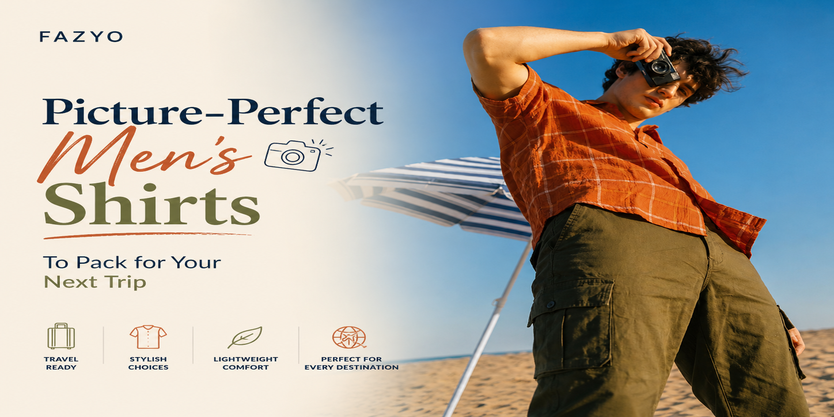
Picture-Perfect Men's Shirts to Pack for Your Next Trip
There's a specific frustration you feel when you get back from a trip with four hundred photos and find that your outfit choices are working against every single one of them. The shirt's too wrinkled. The color's washing out against the background. The fit is doing something strange to your silhouette in every wide shot.
The shirts you pack for a trip need to do two things: look good in person and look good in photos. Those are related but not identical requirements. A shirt that photographs well has a specific set of qualities — color saturation, fabric texture, and fit that reads clearly even when a camera compresses three dimensions into two.
Getting this right doesn't require new clothes. It requires choosing the right ones.
Colors That Win in Every Light
Indian travel destinations — Rajasthan's terracotta architecture, the deep blues of a Udaipur lake, the greens of Kerala's backwaters — provide the kind of backdrops that reward certain shirt colors and punish others.
Deep jewel tones are the most photograph-friendly colors in natural light. Navy, emerald, burgundy, cobalt — these colors have saturation depth that the camera reads accurately. They don't blow out in midday sun, they don't flatten in overcast light, and they create clear contrast against most architectural and natural backgrounds.
White shirts photograph with the most flexibility across every lighting condition, but carry the constant risk of overexposure in bright outdoor shots. If you pack a white shirt for men, it earns its place — just reserve it for early mornings or late evenings when the light is softer.
Avoid mid-tone greys and muddy greens for photography. They lose definition under most travel conditions.
Fabrics That Travel and Photograph Well
Linen wrinkles immediately. Cotton wrinkles over hours. Synthetic blends often don't wrinkle but reflect light strangely on camera. The sweet spot for travel photography is a mid-weight cotton with enough structure to hold shape through a full day of walking, but enough natural texture to look intentional — not like it came straight off a steamer.
A textured cotton casual shirt for men — subtle weave or herringbone surface — photographs with depth. The texture creates micro-shadows that a flat fabric doesn't, and micro-shadows are what give a garment dimension in a photograph. Plain poplin looks fine in person. It can read flat on camera.
Pack fabrics that have something to say. Solid colors, interesting textures, clean construction.
The Fits That Work in Wide-Angle Shots
Travel photography, more than any other context, exposes fit problems because you're often shot at a distance — full body in a landscape, standing in front of a fort, walking through a market. At those distances, a bad fit reads as an amorphous shape rather than a well-dressed person.
Slim or regular fit with clean lines across the shoulder and chest reads best from distance. The silhouette should be clear. Avoid very loose fits that read as shapeless in wide shots, and avoid very tight fits that photograph as strained or uncomfortable.
The tucked-in shirt reads better in architectural settings — clean geometry against clean geometry. The untucked shirt works better in natural or market settings where the relaxed aesthetic matches the environment.
Consider the destination before deciding which approach your shirts for men will follow on the trip.
The Exact Packing List for Photography-Ready Shirts
Three shirts for a five-day trip. One in a deep jewel tone for golden-hour and architectural shots. One in white or off-white for beach and water settings. One in a neutral mid-tone — olive, stone, or slate — for interior shots and darker backgrounds.
All three should be in solid colors. The camera simplifies everything — a pattern that looks interesting in person can read as noise in a wide shot. Solids communicate clearly at every scale.
Pair with jeans for men in dark wash or cargo pants in neutral khaki, and you have visual combinations that work across every lighting condition and setting type you'll encounter on a standard Indian travel itinerary.
What Makes a Shirt Trip-Proof Beyond Photography
Wrinkle resistance and quick recovery from being packed. A shirt that requires ironing the moment you unpack it isn't trip-proof — it's trip-dependent on finding an iron, which is never guaranteed. Good cotton recovers from being folded if you hang it in a bathroom with hot steam for ten minutes. Linen and linen-blends recover even more easily.
Roll your shirts rather than folding them. The rolling method reduces crease points and keeps collars from getting crushed at the bottom of a bag. It also takes up less space — critical if you've committed to packing a cabin bag.
Simple logistics. Better photos. Less time frustrated in the room trying to get your shirt to cooperate.
Frequently Asked Questions
What color shirts photograph best on vacation?
Deep jewel tones — navy, cobalt, burgundy, forest green — photograph most consistently well across changing light conditions. They hold color saturation in bright sunlight without blowing out, and they read clearly against natural and architectural backgrounds. For versatility, a deep-tone shirt for men in navy is the single most photograph-friendly piece you can pack.
How many shirts should I pack for a 5-day trip?
Three shirts is the ideal number for a five-day trip — one for photography-first situations, one utility shirt for active days, one that can dress up for evenings. Combined with two t-shirts for men and a pair of trousers, three shirts give you more outfit combinations than you'll exhaust in five days.
What fabric shirt doesn't wrinkle on long journeys?
Mid-weight cotton blended with a small percentage of elastane or similar stretch fiber wrinkles significantly less than pure cotton and recovers faster when unpacked. Pure linen wrinkles dramatically but recovers well with steam. For long road trips or flights, the cotton-stretch blend keeps you looking reasonably pressed from airport to hotel room without ironing.
Should I pack patterned shirts or solid shirts for travel?
Solid shirts are the correct choice for travel. They photograph cleanly at any distance, pair with any bottom in your bag, and don't require matching to anything else. A patterned shirt narrows the coordination options it works with and can read as visually busy in wide-angle travel shots. Pack solids — the flexibility they offer on a trip is worth far more than the interest a pattern provides.
Browse our full range of casual shirts for men — solid colors, travel-ready fabrics, and fits designed for the real world. Pick your three, pack them well, and they'll carry you through every photo on the trip.
Read more

The vacation wardrobe mistake isn't buying cheap clothes. It's buying many cheap clothes that don't work together. You end up with a suitcase full of options and nothing to actually wear — every co...

A dress is the most efficient thing in your suitcase. One piece, complete outfit, nothing to coordinate. This is obvious and yet most women still pack three separate tops and three separate bottoms...